Hypothetical: If you had been given the opportunity to start an NFL expansion team before the 2012 season, how would you allocate your $120.8 million salary cap to your new roster? Would you use $13.25 million (nearly 12%) on a wide receiver, like the Cardinals? Or $19.035 million (over 15%) on a defensive end, like the Colts?

Strategically structuring contracts to maximize the talent on NFL rosters is an art in itself. Each owner, general manager, and coach have their own opinions on how money should be spent. Yet, most teams seemingly agree that the quarterback position should have the most money per player allocated to it.

Yet, how do you evaluate the success of an investment in a quarterback?

You evaluate quarterbacks relative to their peers, and you pay them according to that success relative to their peers.

The quarterback is the most highly valued position in the game, and thus, quarterbacks are paid on average more than any other position in the league. Fortunately, due to the NFL’s salary cap rules, teams may sign players with a signing bonus that may be prorated across the life of the contract. Thus, the amount of money allocated to the salary cap is not always the amount of money a player was actually paid that year. This allows teams to offer players a large sum of money up front without the salary cap taking a “hit” for the signing bonus in its entirety. For example, in July of 2012, Drew Brees signed a 5-year contract worth $100 million with a $37 million signing bonus. Here is what Brees is scheduled to actually receive each year under this contract:

Year

Base Salary

Signing Bonus

Workout Bonus

Total

2012  $3,000,000 $37,000,000  $0 $40,000,000
2013  $9,750,000 $0  $250,000 $10,000,000
2014  $10,750,000 $0  $250,000 $11,000,000
2015 $18,750,000 $0  $250,000 $19,000,000
2016 $19,750,000 $0  $250,000 $20,000,000

But, since the Saints may prorate the signing bonus across the life of the contract, here’s the actual “hit” the Saints’ salary cap is taking from Brees’ contract:

Year

Base Salary

Signing Bonus

Workout Bonus

Cap Hit

2012  $3,000,000  $7,400,000  $0  $10,400,000
2013  $9,750,000  $7,400,000  $250,000  $17,400,000
2014  $10,750,000  $7,400,000  $250,000  $18,400,000
2015  $18,750,000  $7,400,000  $250,000  $26,400,000
2016  $19,750,000  $7,400,000  $250,000  $27,400,000

This mechanism allows teams to maneuver contracts and “even” out the Cap Hit to fit the salary cap. The 2012 NFL salary cap was $120.6 million. Thus, the Saints had $110.2 million to allocate to the rest of the team for this past season. Keep in mind that if the Saints were forced to use the amount they actually paid Brees in 2012, it would remove $40 million from the team’s 2012 salary cap instead of $10 million.

The reason the Cap Hit is more important in this analysis than (1) the amount a player was actually paid or (2) the average salary they will be paid over the course of a contract is that the Cap Hit is specifically representative of the cap room a player is taking up in a given year. Thus, it informs us as to the amount of money that is available to allocate to other players on a specific team.

So, now that we’re all salary cap experts, let’s talk about a valuation process for the most pivotal position on the field: the kicke… quarterback. The Quarterback.

There is no exact method in determining a quarterback’s performance over the course of a year. In 1971 the NFL came up with the “Passer Rating,” which rated quarterbacks on a scale of 0 to 158.3. The formula for this rating was:

Passer Rating = [ (4.16667 x [ ( 20 x Completions ) + Yards + ( 80 x Touchdowns ) - ( 100 x Interceptions ) ] ) / Attempts ] + 2.083

This rating system contained some major flaws. To illustrate these flaws, here’s 3 examples:

1. Quarterback A throws 10 passes. He completes 5 of the passes for a total of 100 yards with 0 touchdowns and 0 interceptions.

A's Passer Rating = [ (4.16667 x [ ( 20 x 5 ) + 100 + ( 80 x 0 ) - ( 100 x 0 ) ] ) / 10 ] + 2.083

A's Passer Rating = 85.4 (Rounded to the nearest tenth)

2. Quarterback B throws 10 passes. He completes all 10 of the passes for a total of 50 yards with 0 touchdowns and 0 interceptions.

B's Passer Rating = [ (4.16667 x [ ( 20 x 10 ) + 50 + ( 80 x 0 ) - ( 100 x 0 ) ] ) / 10 ] + 2.083

B's Passer Rating = 87.5 (Rounded to the nearest tenth)

3. Quarterback C throws 10 passes. He completes 8 of the passes for 90 yards with 1 touchdown scored on a 62-yard screen play to the running back and 2 interceptions, which both are returned for touchdowns.

C's Passer Rating = [ (4.16667 x [ ( 20 x 8 ) + 90 + ( 80 x 1 ) - ( 100 x 2 ) ] ) / 10 ] + 2.083

C's Passer Rating = 97.9 (Rounded to the nearest tenth)

At a glance…

QB

Comp.

Att.

Yards

TD

Int.

Rating

A 5 10 100 0 0 85.4
B 10 10 50 0 0 87.5
C 8 10 90 1 2 97.9

As is evident in the examples, this passer rating gives too much weight to completion percentage. It also accounts for specific occurrences that are not attributable to the quarterback, such as an on-target pass that goes through the hands of the receiver and is intercepted or an 80-yard touchdown that was scored on a shovel pass to the running back.

So in an effort to create a more reliable quarterback rating system, ESPN teamed up with AdvancedNFLStats.com and FootballOutsiders.com to create the Total Quarterback Rating (“QBR”). QBR takes into account the “contexts and details of throws” and is scored on a scale of 0 to 100, where the average NFL quarterback would be a 50. While QBR is not perfect, it is a far better representation of a quarterback’s performance than the classic passer rating, so we’ll use it to measure quarterback performance.

Here are the 36 quarterbacks that played enough during the 2012 NFL season to qualify for ESPN’s QBR, along with their respective cap hits:

PLAYER

QBR

Cap Hit

Peyton Manning 84.1  $18,000,000
Tom Brady 77.1  $8,000,000
Colin Kaepernick 76.8  $1,164,610
Matt Ryan 74.5  $12,990,000
Aaron Rodgers 72.5  $9,000,000
Robert Griffin III 71.4  $3,839,836
Alex Smith 70.1  $9,500,000
Russell Wilson 69.6  $544,850
Drew Brees 67.9  $10,400,000
Eli Manning 67.4  $9,600,000
Andrew Luck 65.0  $4,015,000
Ben Roethlisberger 62.8  $9,895,000
Tony Romo 62.7  $8,469,000
Matt Schaub 62.6  $11,700,000
Matthew Stafford 58.9  $9,842,083
Cam Newton 54.2  $5,005,659
Christian Ponder 53.8  $2,308,795
Josh Freeman 53.1  $7,915,000
Ryan Tannehill 52.3  $2,302,500
Jay Cutler 51.9  $9,600,000
Sam Bradford 51.6  $15,595,000
Andy Dalton 50.7  $1,185,045
Matt Hasselbeck 48.5  $7,500,000
Jake Locker 48.1  $2,860,455
Joe Flacco 46.8  $8,000,000
Michael Vick 46.0  $13,900,000
Ryan Fitzpatrick 45.8  $6,000,000
Nick Foles 45.3  $525,812
Carson Palmer 44.7  $4,716,667
Blaine Gabbert 40.9  $2,727,647
Philip Rivers 40.6  $15,310,000
Matt Cassel 36.5  $7,575,000
Chad Henne 29.9  $2,600,000
Brady Quinn 27.4  $1,500,000
Brandon Weeden 26.6  $1,469,500
Mark Sanchez 23.4  $7,853,125

Logically, the best quarterback in the league is worth the most money, so a team should be willing to allocate the highest percentage of their salary cap to the best quarterback. Along the same logic, in a perfect world the second best quarterback should have received the second highest salary (or respective cap hit). But it’s not a perfect world, so in order to illustrate this relationship, I ranked 2012’s highest QBRs and Cap Hits from 1 to 36:

Rank

QBR

Cap Hit

1 84.1  $18,000,000
2 77.1  $15,595,000
3 76.8  $15,310,000
4 74.5  $13,900,000
5 72.5  $12,990,000
6 71.4  $11,700,000
7 70.1  $10,400,000
8 69.6  $9,895,000
9 67.9  $9,842,083
10 67.4  $9,600,000
11 65.0  $9,600,000
12 62.8  $9,500,000
13 62.7  $9,000,000
14 62.6  $8,469,000
15 58.9  $8,000,000
16 54.2  $8,000,000
17 53.8  $7,915,000
18 53.1  $7,853,125
19 52.3  $7,575,000
20 51.9  $7,500,000
21 51.6  $6,000,000
22 50.7  $5,005,659
23 48.5  $4,716,667
24 48.1  $4,015,000
25 46.8  $3,839,836
26 46.0  $2,860,455
27 45.8  $2,727,647
28 45.3  $2,600,000
29 44.7  $2,308,795
30 40.9  $2,302,500
31 40.6  $1,500,000
32 36.5  $1,469,500
33 29.9  $1,185,045
34 27.4  $1,164,610
35 26.6  $544,850
36 23.4  $525,812

Using the table above, I created a scatter plot, with the X-axis representing QBR and the Y-axis representing the Cap Hit. Once all of the points were on the chart, I had excel create a “trend line” to represent the average relationship between Salary Cap Hit and QBR. Interestingly, an exponential relationship exists between Cap Hit and QBR. This is due to teams’ willingness to pay exponentially more money for the more elite quarterbacks. The trend line can be seen in the scatter-plot chart below:
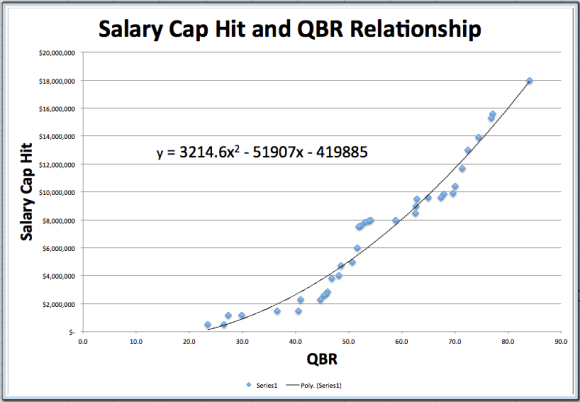
Salary Cap Hit and QBR Relationship

As you can see, the trend line’s formula in the chart is:

y = 3,214.6(x)2 - 51,907x - 419,885

To demonstrate the applicability of this formula, here’s an example:

In 2012 Jake Locker had a QBR of 48.1. Since QBR is the X-axis of the chart, we’ll plug Locker’s QBR into the formula to determine how large of a salary cap hit his performance warranted:

Salary Cap Hit = (3,214 x (48.1)2) - (51,907 x 48.1) - 419,885

…I hate to ruin the fun as you scramble to find your old TI-83 calculator, but here’s the answer:

Salary Cap Hit = $5,360,489

In other words, relative to other quarterbacks in the NFL, Jake Locker’s performance at quarterback was worth a team taking up to a $5,360,489 cap hit for him, thus I deemed this amount a player’s “Cap Hit Value” for a given year. Here’s the “Cap Hit Value” for all 36 quarterbacks in 2012:

PLAYER

QBR

Cap Hit Value

Peyton Manning 84.1  $18,790,761
Tom Brady 77.1  $15,526,756
Colin Kaepernick 76.8  $15,393,910
Matt Ryan 74.5  $14,394,647
Aaron Rodgers 72.5  $13,553,369
Robert Griffin III 71.4  $13,101,627
Alex Smith 70.1  $12,577,781
Russell Wilson 69.6  $12,379,195
Drew Brees 67.9  $11,716,024
Eli Manning 67.4  $11,524,509
Andrew Luck 65.0  $10,627,615
Ben Roethlisberger 62.8  $9,837,993
Tony Romo 62.7  $9,802,841
Matt Schaub 62.6  $9,767,753
Matthew Stafford 58.9  $8,514,685
Cam Newton 54.2  $7,049,863
Christian Ponder 53.8  $6,931,755
Josh Freeman 53.1  $6,727,542
Ryan Tannehill 52.3  $6,498,012
Jay Cutler 51.9  $6,384,790
Sam Bradford 51.6  $6,300,549
Andy Dalton 50.7  $6,051,297
Matt Hasselbeck 48.5  $5,463,938
Jake Locker 48.1  $5,360,489
Joe Flacco 46.8  $5,031,383
Michael Vick 46.0  $4,834,257
Ryan Fitzpatrick 45.8  $4,785,618
Nick Foles 45.3  $4,665,146
Carson Palmer 44.7  $4,522,702
Blaine Gabbert 40.9  $3,674,304
Philip Rivers 40.6  $3,611,279
Matt Cassel 36.5  $2,807,930
Chad Henne 29.9  $1,741,750
Brady Quinn 27.4  $1,411,026
Brandon Weeden 26.6  $1,313,681
Mark Sanchez 23.4  $965,448

Obviously, some of these quarterbacks were paid much less than their Cap Hit Value, while some were paid much more. I’m going to call the difference between a player’s Cap Hit Value and their actual Cap Hit “Net Value.” While the Cap Hit Value represents the average amount teams paid for a particular QBR, the Net Value represents whether teams actually gained money or lost money on their investment.

For instance, the Seattle Seahawks took a $544,850 Cap Hit for Russell Wilson, yet he played up to the market value of a quarterback worth $12,379,195. Thus, his Net Value for the Seattle Seahawks was $11,834,345. While on average other teams had to pay an additional $11.8 million in 2012 to receive the caliber of play Russell Wilson provided the Seahawks with, Seattle was able to use that $11.8 million elsewhere. In essence, Net Value is simply how overvalued or undervalued a quarterback was in a particular year.

Here’s all 36 quarterbacks in order by their Net Value in 2012:

Player

QBR

Cap Hit

Cap Hit Value

Net Value

Colin Kaepernick* 76.8  $1,164,610  $15,393,910  $14,229,300
Russell Wilson* 69.6  $544,850  $12,379,195  $11,834,345
Robert Griffin III* 71.4  $3,839,836  $13,101,627  $9,261,791
Tom Brady* 77.1  $8,000,000  $15,526,756  $7,526,756
Andrew Luck* 65.0  $4,015,000  $10,627,615  $6,612,615
Andy Dalton* 50.7  $1,185,045  $6,051,297  $4,866,252
Christian Ponder* 53.8  $2,308,795  $6,931,755  $4,622,960
Aaron Rodgers* 72.5  $9,000,000  $13,553,369  $4,553,369
Ryan Tannehill 52.3  $2,302,500  $6,498,012  $4,195,512
Nick Foles 45.3  $525,812  $4,665,146  $4,139,334
Alex Smith 70.1  $9,500,000  $12,577,781  $3,077,781
Jake Locker 48.1  $2,860,455  $5,360,489  $2,500,034
Cam Newton 54.2  $5,005,659  $7,049,863  $2,044,204
Eli Manning 67.4  $9,600,000  $11,524,509  $1,924,509
Matt Ryan* 74.5  $12,990,000  $14,394,647  $1,404,647
Tony Romo 62.7  $8,469,000  $9,802,841  $1,333,841
Drew Brees 67.9  $10,400,000  $11,716,024  $1,316,024
Blaine Gabbert 40.9  $2,727,647  $3,674,304  $946,657
Peyton Manning* 84.1  $18,000,000  $18,790,761  $790,761
Ben Roethlisberger 62.8  $9,895,000  $9,837,993  $(57,007)
Brady Quinn 27.4  $1,500,000  $1,411,026  $(88,974)
Brandon Weeden 26.6  $1,469,500  $1,313,681  $(155,819)
Carson Palmer 44.7  $4,716,667  $4,522,702  $(193,965)
Chad Henne 29.9  $2,600,000  $1,741,750  $(858,250)
Josh Freeman 53.1  $7,915,000  $6,727,542  $(1,187,458)
Ryan Fitzpatrick 45.8  $6,000,000  $4,785,618  $(1,214,382)
Matthew Stafford 58.9  $9,842,083  $8,514,685 $(1,327,398)
Matt Schaub* 62.6  $11,700,000  $9,767,753  $(1,932,247)
Matt Hasselbeck 48.5  $7,500,000  $5,463,938  $(2,036,062)
Joe Flacco* 46.8  $8,000,000  $5,031,383  $(2,968,617)
Jay Cutler 51.9  $9,600,000  $6,384,790  $(3,215,210)
Matt Cassel 36.5  $7,575,000  $2,807,930  $(4,767,070)
Mark Sanchez 23.4  $7,853,125  $965,448  $(6,887,677)
Michael Vick 46.0  $13,900,000  $4,834,257  $(9,065,743)
Sam Bradford 51.6  $15,595,000  $6,300,549  $(9,294,451)
Philip Rivers 40.6  $15,310,000  $3,611,279  $(11,698,721)

*Made playoffs as a starting QB (Alex Smith made playoffs, but not as a starting QB)

The most fascinating part of this chart is that every one of the top 8 quarterbacks, with respect to their net value, made the playoffs. This illustrates the principle that teams who effectively evaluate talent and draft or sign quarterbacks (or really any position) for lower than their eventual performance on the field have more money to spend in other areas, and thus, more overall talent on their roster. While this conclusion is a simple generalization, common sense seems to deem it meritorious.

To close quite simply, Colin Kaepernick, Russell Wilson, Robert Griffin III, Tom Brady, and Andrew Luck gave their teams the most “bang for their buck” in 2012, while Matt Cassel, Mark Sanchez, Michael Vick, Sam Bradford, and Philip Rivers played far below their pay grade.

But Philip Rivers, if you’re reading this, don’t despair… in 2010 Jamarcus Russell did not play a down for the Oakland Raiders and was paid $19.92 million for a Net Value of $(19,919,100), all of which was applied to the cap (thankfully for the Raiders, it was an uncapped year). Let’s just hope Jamarcus Russell makes this return he’s talking about, so that I can do this next year, and he can shatter any semblance of a record low that you may currently hold, Philip.

————

By: Tyler Raborn

Many fans believe that recruiting is the key to success in college football.

Is that the case? Is college football strictly dictated by recruiting? Are teams’ accomplishments directly related to their recruiting classes?

Umm… kinda, sorta, and maybe.

After 10-20 hours of research and building an excel file that would make Nate Silver proud, those are the answers I came up with— total indecision.

But what my research did determine was data showing the most overachieving and underachieving teams of the past 7 years.

The terms “overachieving” and “underachieving” are in regards to the relationship between the amount of talent on a given team and their actual performance with that talent.

So what defines a team’s “talent”?

I used the most objective formula that I could come up with to determine talent. And while I know this method has several exceptions and is extremely broad, it is the most effective method that I could come up with, without doing individual team analyses. So, keep in mind, this is all done to give a broad picture of a general idea— not a detailed team-by-team analysis.

First, I collected all of the recruiting data available from two of the most respected sources in the college football recruiting industry: Scout, Inc. and Rivals. Both Scout and Rivals’ data goes back to 2002, so I collected all of the team rankings in recruiting from 2002 to 2012 from each site and inserted them into an excel file. Then, I averaged the rankings together to come up with an objective “composite score” to represent each team for each year.

For example, in 2003 Scout ranked Florida State’s recruiting class 12th in the nation, while Rivals ranked them 21st in the nation. Thus, their composite score was a ranking of 16.5.

Next, I devised a formula to account for all of the recruiting classes on an individual team. After examining several depth charts, I determined the following weights for each class:

Freshman- 12.5%
Sophomore (or Redshirt Freshman)- 22.5%
Junior (or Redshirt Sophomore)- 25%
Senior (or Redshirt Junior)- 27.5%
5th Year Senior- 12.5%

So,the formula to determine, what I will call, the “talent quotient” on a particular team is:

( .125 x Composite Score of Freshman Class ) + ( .225 x Composite Score of Sophomore Class ) + ( .25 x Composite Score of Junior Class ) + ( .275 x Composite Score of Senior Class ) + ( .125 x Composite Score of 5th Year Senior Class ) = Talent Quotient

For instance, to determine the talent quotient of the 2006 Florida State team, we simply need to plug in the composite scores of each recruiting class into the formula. Here’s Florida State’s 2002 – 2006 recruiting class ranks:

Year

Scout, Inc.

Rivals

Composite Score

2002 6 4 5
2003 12 21 16.5
2004 4 3 3.5
2005 3 2 2.5
2006 12 3 7.5

So, inputting the 5 composite scores into the formula would give us the following:

( .125 x 7.5 ) + ( .225 x 2.5 ) + ( .25 x 3.5 ) + ( .275 x 16.5 ) + ( .125 x 5 ) = 7.5375

Thus, the 2006 Florida State team had a talent quotient of 7.5375, which was the 5th lowest score in the nation. Hence, according to the formula, the 2006 Florida State Seminoles had the 5th most talented team in all of college football.

Once I had determined the talent quotient for every team in the FBS for the 2006 season, I ranked each team by their talent quotient, with the lowest score ranked number 1, the second lowest ranked number 2, and so on. Then, I repeated the process for 2007, 2008, 2009, 2010, 2011, and 2012 seasons.

The logic behind this process is simple: the teams with more talent should beat the teams with less. So, the higher ranked “talent quotient,” the more talent a team can field in a game. In other words, the number 1 ranked team in talent, all other things being equal (they’re not), should beat the number 2 ranked team in talent.

After ranking every FBS college football team from 2006 until 2012, I compared these ranks to how the teams finished in the final college football polls. In an effort to make this process more objective, I averaged the final AP polls with the final USA Today polls to determine a general end of the year ranking for each team. The purpose of this method is to compare how a team performed relative to the talent on the team.

So after inventing a “talent quotient,” ranking teams by that invented number, comparing those ranks to the ranks of plausibly inaccurate year end poll rankings, I came up with the most overachieving and underachieving college football programs over the last 7 years…

*Drumroll*

The Most Overachieving Programs

Four teams stood far above the rest in regards to their ability to play at a level far above what the talent on their team would indicate they were capable of. Fans and analysts offer up a multitude of reasons for these teams’ success, such as: coaching, strength of schedule, and a plethora of other factors, both negative and positive, in an attempt to explain these teams’ habits of winning seemingly far beyond their talent level. Yet, no matter what your biased opinion may be, you have to admit, what these 4 teams have done with the talent on their rosters is nothing short of impressive.

BYU

4. BYU

Year

Talent Quotient Ranking

Final Poll Ranking

2006 59th 15th*
2007 59th 14th*
2008 59th 25th*
2009 56th 12th
2010 54th NR
2011 53rd 25th*
2012 51st NR

Cincinnati

3. Cincinnati

Year

Talent Quotient Ranking

Final Poll Ranking

2006 91st NR
2007 88th 18th
2008 80th 17th
2009 74th 8th
2010 67th NR
2011 59th 25th
2012 57th 24th

TCU

2. TCU

Year

Talent Quotient Ranking

Final Poll Ranking

2006 62nd 21st*
2007 62nd NR
2008 68th 7th
2009 71st 6th
2010 74th 2nd
2011 65th 13th
2012 53rd NR

Boise State

1. Boise State

Year

Talent Quotient Ranking

Final Poll Ranking

2006 75th 5th
2007 67th NR
2008 67th 12th
2009 68th 4th
2010 70th 8th
2011 73rd 7th
2012 71st 16th

And onto the more entertaining part of this column…

The Most Underachieving Programs

A.K.A. the laughing stock of college football. These teams recruit some of the most talented players in the country year in and year out, but over the past 7 years, they’ve had an extraordinarily hard time making that talent translate to success on the field. An important factor to take into consideration is that I have adjusted the formula that I used to determine these rankings to add more weight to higher ranked teams. The logic behind this adjustment is simple. Without the adjustment, a team that finishes the season ranked 67th and has a talent quotient ranking of 49th is a bigger letdown (or “underachiever”) than a team that has the number 1 ranked talent quotient and loses 3 games to finish the season ranked 17th. And, in my opinion, the team that has the most talent in the country, but manages to lose 3 games and wind up out of the top 15, is a bigger underachiever than a team with mediocre talent performing a little less than mediocre. Thus, this adjustment gives much more weight to teams with higher ranked talent quotients. So, without further ado, here’s your top 7 most underachieving college football programs over the last 7 years…

Notre Dame

7. Notre Dame

Year

Talent Quotient Ranking

Final Poll Ranking

2006 15th NR
2007 19th NR
2008 14th NR
2009 9th NR
2010 9th NR
2011 10th NR
2012 12th 3rd

Tennessee

6. Tennessee

Year

Talent Quotient Ranking

Final Poll Ranking

2006 9th 24th
2007 10th 12th
2008 11th NR
2009 14th NR
2010 14th NR
2011 14th NR
2012 13th NR

Georgia

5. Georgia

Year

Talent Quotient Ranking

Final Poll Ranking

2006 3rd 25th
2007 3rd 3rd*
2008 3rd 12th*
2009 3rd NR
2010 6th NR
2011 6th 20th*
2012 7th 5th

Michigan

4. Michigan

Year

Talent Quotient Ranking

Final Poll Ranking

2006 8th 9th*
2007 4th 19th*
2008 4th NR
2009 6th NR
2010 8th NR
2011 12th 11th*
2012 11th 25th

FSU

3. Florida State

Year

Talent Quotient Ranking

Final Poll Ranking

2006 5th NR
2007 7th NR
2008 7th 22nd
2009 12th NR
2010 13th 17th*
2011 9th 23rd
2012 5th 9th

USC

2. USC

Year

Talent Quotient Ranking

Final Poll Ranking

2006 1st 4th
2007 1st 3rd*
2008 1st 3rd*
2009 1st 21st
2010 1st NR
2011 2nd 16th
2012 3rd NR

Miami

1. Miami (FL)

Year

Talent Quotient Ranking

Final Poll Ranking

2006 4th NR
2007 8th NR
2008 9th NR
2009 11th 19th
2010 12th NR
2011 13th NR
2012 15th NR

*Rounded numbers

One last interesting fact to consider is that no team in the past 7 years has won a National Championship without a talent quotient ranking below 10th. So, while it is very possible for teams to crack the Top 25 without Top 25 talent, it is much more difficult to make it to, and win, the National Championship without elite talent.

So, in conclusion… as if you didn’t already whine about your college football team enough, I hope that I’ve provided you with further information to sulk about— the 7 years of your life that you’ve been continuously letdown as a fan.

————

By: Tyler Raborn

In honor of Ray Lewis’ impending retirement, for the next five days, I’ll be posting one inspirational video a day.

Video #1: Al Pacino’s Inspirational Speech in Any Given Sunday

One time in 3rd grade I got caught chewing gum in class. Chewing gum was against the rules. So, I was mortified as to the possible outcome of my indictment — the teacher telling my parents.

My teacher approached me, leaned over, and whispered, “Just don’t put it under the desk.”

… I was elated. I didn’t get in trouble. All I had to do was throw it away in the trash can. It was the single biggest relief of my, now seemingly, pathetic childhood. I, along with the rest of my classmates, chewed gum in class that entire year.

Then came 4th grade, and the end of my gum-chewing days. In fact, on the first day of school, the teacher sent me to the principal’s office… for chewing gum?!?

What defines a “rule”?

Is a rule some lofty ideology transcribed in some rarely read book?

OR

Is a rule dependent upon the application of that lofty, rarely read, ideology?

I would argue that, in realistic application, a rule is only as good as its enforcement. It seems to be human nature to push the limits if they benefit us in some way. Thus, we, as a society, often seek to find those limits in the currently “grey area” of all aspects of life. Including sports. And including baseball.

Why do the steroid era players deserve to be in the Hall of Fame?

Because they were the best of the best, in their era, operating under that era’s “rules.”

At the height of steroid era, players were hitting 50, 60, and even 70 home runs a season. And as a Nike commercial infamously pointed out, “Chicks dig the long ball.”

Power hitting was good for baseball. At least, it was good for the sale of baseball as a product to the general public. Fans wanted to see home runs, so baseball wanted to deliver them. When players began amassing abnormal amounts of muscle in a short amount of time, baseball didn’t investigate them. Conversely, the MLB turned a blind eye.

So, what did players begin to do? They juiced up. And, why wouldn’t they? Pitchers were facing stronger hitters, and hitters were facing harder throwing, quicker recovering, pitchers. Ball players had to do it to keep up with the rest of the league. They did it to stay competitive or to become more competitive. In the end, they did it to help their team win.

Along with winning comes accolades, records, and money, which made winning even more enjoyable. And, subsequently, made steroids more inevitable.

But, what if baseball had strict regulations, tough testing policies, and extreme punishments for those who were caught using performance enhancing drugs (“PEDs”)?

Then none of the great players would have used them. Every time Bonds, Clemens, etc. shot up, they did a balancing test in their head. Did the benefits outweigh the costs? Yes- they absolutely did. Baseball was eating up their dominating performances. They were being immortalized, getting huge contracts, and breaking records. And, what if they didn’t? Their thought process must have considered the guys who did take PEDs and those players’ chances of over taking their current status in baseball if they didn’t use PEDs.

So, if baseball had stricter regulations, tougher testing policies, and extreme punishments for those who were caught using PEDs, players would have weighed the benefits and costs and determined that it simply wasn’t worth it. Why risk using PEDs if, hypothetically, the consequences were to be suspended an entire year and have an entire career of work and accomplishments erased for a tail end chase at glory?

Players would have been discouraged from using PEDs so that they would not hurt their teams, themselves, or their legacies.

BUT there weren’t strict regulations, tough testing policies, and extreme punishments for those who were caught using PEDs.

I know. And that is why a majority of the blame for these great players using PEDs should be on the league. Players, who had excelled their whole lives in baseball and were natural die-hard competitors, were going to do everything in their power to be the best they could be, within the “rules” of the game.

If it had been one or two players caught using PEDs, then they wouldn’t deserve the hall of fame, but since it was hundreds of players, those using PEDs were not given an edge, but merely staying with the pack.

It was an even playing field, in which the great players were great.

We judge players relative to the generation they played in. No one voting on the basketball hall of fame is going to compare LeBron James to Bob Cousy. We compare players’ accomplishments relative to the players of their time period. It’s a simple fact that athletes have become bigger, faster, and stronger than sixty years ago, and if LeBron had played in the 50’s, he may have averaged 50 points and 30 rebounds a game… or more. But he doesn’t get to play against the players of the 50’s, and by the same token, Cousy doesn’t have to play against the players of today.

Applying the same logic, baseball’s hall of famers didn’t have to play in an era when everyone was using steroids — and getting away with it. If they had played “clean,” then they may not have even had the careers that they had in their own eras.

*And as a side note, I simply don’t buy the “innocent until proven guilty” arguments. The media attention was on the great players that had allegations against them stemming from different investigations, but they were far from the only ones. It’s logical to assume that some players were using them simply to take themselves from bad to mediocre to prolong their careers. It’s called the “steroid era” and not the “steroid incident” for a reason.

Today, no player was voted into the baseball hall of fame, and it’s a shame.

Eventually, I hope that changes. There are several guys who deserve to be in. And do not misunderstand me, I do not approve of the use of PEDs and in no way condone of their use in baseball. I simply believe they were great players who worked within the boundaries the MLB had established to become some of the greatest players of all time, and these players shouldn’t be punished for being products of their environments.

If anyone should be blamed for baseball’s black eye known as the “steroid era,” it’s the owners and the league. Their application, or lack thereof, a “rule” evolved over time, and these great players, and their denial into the hall of fame, are the casualties of this unfair evolution.

————

By: Tyler Raborn

Ray Lewis: The Man

Philip Matthews —  Wednesday, January 9, 2013 — 3 Comments

He waits.

You can imagine the anticipation gazing through a tunnel of smoke with 71,379 people ready to erupt upon your arrival.

And then it happens.

“13-time Pro-Bowler. Two-time NFL Defensive Player of the Year. Linebacker #52 Ray Lewis.” The P.A. announcer exclaims as Ray Lewis shoots through the haze, accompanied by Nelly’s “Hot in Here,” and performs his renown “squirrel” dance to perfection–even with a torn right triceps.

It was an average game for the legend, as the Ravens defeated the Colts to prolong Ray’s “last ride,” as he put it. But nonetheless, it was an unforgettable day for all those lucky ones in attendance–fans, players, and coaches alike.

Greatest of all time? This is a very weighty phrase that if thrown around lightly can instantly kill the credibility of the one saying or writing it.

It can easily be argued that Ray is the greatest middle linebacker of all time. Along with Dick Butkus and Mike Singletary, there’s no question #52 has a case to be at the top of this list. His numbers and accolades carry a reputation of their own: 13 Pro Bowls, 10-time AP All-Pro, two-time NFL Defensive Player of the Year, Super Bowl MVP, and easily a first-ballot Hall of Famer.

However, for a second, let’s focus on the growth of Ray Lewis the man, not so much the football player. I believe it can also be argued that over the course of his 17-year NFL career, Ray Lewis has had one of the greatest maturations of all time.

What’s interesting in all of this publicity surrounding the career and last ride of Lewis, and deservedly so, lies the fact that we don’t hear anything about the past. No, we don’t see the images of him in an orange jumpsuit in Georgia before he agreed to a guilty plea to a misdemeanor charge of obstruction of justice after being initially indicted on murder and aggravated assault charges from an Atlanta homicide in 2000. These charges were all acquitted, and the incident seemed to quickly recede, as Ray proclaimed his innocence and eventually won back his reputation via the court of public opinion. We don’t hear about his struggles with women, or his six kids of four different mothers.

No, these images are distantly in the rearview mirror, due in large part to the change that has taken place inside of Ray. A change that has propelled him to vow to be a better example and father figure, as well as mobilized him to take part in countless community-building and charity actions, including one in Ethiopia to help create a sports program for land mine victims.

So just why do we love Ray Lewis? I think some of it is definitely the dominance on the field, the captivating dance, and the exhilarating speeches that could make any red-blooded human ready for war.

All of these certainly make Ray Lewis the fascinating figure he is, but I believe that in addition to these captivating aspects, we love him because we can relate to Ray Lewis off the field. Is he perfect? By no means. But, then again, neither are we. I’m not even saying he is the best role model. But, we live in an imperfect world in dire need of grace from above daily, and I think somewhere along the line of his storied career, Ray has begun to grasp that and live it out.

Unless he’s talking about being blessed and fortunate for the opportunity, his press conferences have shifted from being about #52 to being about his gratitude towards the fans, teammates, coaches, and the organization. Most importantly, he’s shifted his focus towards his family and being the father that he never really had to his sons. He speaks more of God and his goodness than the trials and adversity he’s been through. After the Ravens defeated the Colts in Lewis’ final game in Baltimore, he paraded around the field in a shirt with “Psalms 91” on the front, which points to God being our refuge and fortress in time of need.

And as we eagerly watch this last ride of #52 patrolling the middle of the field this postseason, we’re already rehearsing what we can tell our kids and grandkids about him. We can only hope that Ray Lewis III, who is now starting his career at the University of Miami, makes our memory of his father a bit clearer and continues to learn from his father’s mistakes, as he grows in wisdom and stature and in favor with God and man.

Because we know his father, Ray Lewis, will be there every step of the way.

————

By: Philip Matthews

Hall Pass

Vance McCullough —  Wednesday, January 9, 2013 — 6 Comments

As members of the Baseball Writer’s Association of America (“BBWAA”) have casted their ballots, we are filled with questions on 2013’s Cooperstown crowning moment.

We could be in store for a surprise as no player could receive the required 75% of the vote (it has happened eight times in the past), or we could see a couple of ballplayers elected in the Hall of Fame this year.

But, there are many questions that one must ask themselves when looking at a hall of fame player:

How do we define greatness? Is it in the number of championships a player has to his name? Is it a career-leading statistic that etches him alongside the greats in the historic books? Is it his consistency as year-to-year All Star and fan favorite?

What if it was all these things? What if it was some combination? …or none of them at all?

What if these heroes we saw were steroid or PED users? What if they had the highest ERA (earned run average) of any player in the hall? What if some considered them a cheater? What if others considered them a hero?

How will we define greatness of those with achievements and asterisks?

These are the questions that baseball writers, historians, and fans are asking themselves on this very day. These questions will not go away, and we may never get the answer we feel is correct, but the show must go on. The ballots are filled out, the votes are in, and the results only hours away.

The voters – who are they?

To gain a vote to induct a player into baseball’s hall, you must be or have been an active member of the BBWAA for 10 consecutive years. Once a writer receives a Hall of Fame vote, he or she is eligible to vote for life. An elector will vote for no more than ten eligible candidates, with no write-in votes allowed.

Decision day is upon us. It is time for the public to see who will be immortalized in baseball’s rich history. Though the question remains, how will these electors cast their ballots?

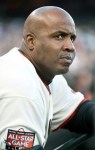
The Baseball Hall of Fame will announce their 2013 induction class, and this year’s candidates have been the most ballyhooed bunch of all time. Bonds, McGwire, Clemens, Palmeiro, Sosa – most top candidates are associated with the juiced era and accused of using.

While others are not regarded as Cooperstown class, see Jack Morris.

To qualify for the Hall players must have played in 10 major league seasons, and the career must have ended five years prior to election. To be voted in, a player must achieve 75% of the vote to become a member of the Hall of Fame.

This is going to be the ongoing debate for years to come – what will the Hall of Fame do with the Steroid Era?

My opinion – it hurts, but it happened. People need to realize there are multiple layers to this story: the users in the game, the League, the Players Union. Everyone shares a responsibility in what is going on in the sport and we simply can’t ignore this time period of the MLB’s history. This era happened, and we must wear it like a boxer wears a black eye after a fight. To tell the history of baseball you cannot omit this storied time period because it was nearly universal, and the full story must be archived in the museum of baseball – Cooperstown.

Isn’t this the nation that loves comeback stories, going from wrong to right, and embraces forgiveness? Isn’t this the story of baseball today? Can we forgive those who did wrong against the game and themselves?

Baseball is the game that has transitioned with this country. It had Jackie Robinson, Ted Williams, Willie Mays, and others serve in world wars, a drug era in the 80’s, gambling issues, court hearings, and now a steroid/PED scandal haunting all who care about the sport they know and love.

And, it seems, this great game of baseball is about to make another transition.  Some will embrace it, and others will be disappointed in the new direction. I don’t know if it will be done today, but I believe the best of the steroid era players will get elected someday – even the accused.

We are all left sitting, waiting, watching for the decision to be final. During these times, where no one knows what is about to come, we all seem as frightened as we are excited about the Hall of Fame’s future.

I know this – I do not have a vote, and I wouldn’t welcome the headache. I love this game and wish it the best, but how do we truly define what the best is for its future?

At 2 PM EST today, January 9th, 2013, the BBWAA decides what is best.

I do know this: I stand for the game of baseball, but the clearness of what is fair or foul has become harder to recognize.

What say you, the sports fan, the baseball fanatic, the opinionated? Who deserves to get in?

Why or why not include those mentioned or unmentioned from the Mitchell Report movement?

Cast your vote in the Comments – let people know how you would vote – because a man’s word still counts for something and we all want to know!

————

By: Vance McCullough

Lebron James (@KingJames) just followed A.J. McCarron’s girlfriend, Katherine Webb (@_KatherineWebb) on Twitter…

LBJ


Watch out A.J.

… and Brent Musburger?

Johnny Manziel was the best player in college football last year. I will accept no other nominations. He won the Heisman his freshman year. No one else has EVER done that, and I won’t even begin to look at his stats.

I don’t remember seeing a guy with his playmaking ability. And before you start posting clips of Tebow and Cam in college, I would argue that they were pure, athletic specimens. Granted Manziel is an incredible athlete as well, but he possesses something beyond just raw athleticism. He has a knack for the big play. He has the feel, for me, of an offensive Honey Badger. He just always seems to be there to make the big play when his team needs it. Hopefully, ole Johnny Football will do a better job at staying away from trouble (although some of his off the field issues already, even before his success, concern me).

This is what I really want to talk about though – Johnny was the best player in college football last year, but at the beginning of August, he wasn’t even clearly the best quarterback on his own team!

Throughout the spring, it was a four-way battle to replace first round pick Ryan Tannehill: Johnny Boy, Jameill Showers, Matt Joeckel, and true freshman Matt Davis. Though, the battle seemed to really be between Manziel and Showers.

But Showers was the presumed favorite throughout the process. Even after the Spring game, everyone seemed convinced that Jameill was going to be the man. Even one week before the announcement, people were still predicting Showers to replace Tannehill.

Sure he was the only one on that list to have any kind of FBS experience, but still. We are not talking about just a couple of average QBs duking it out for a spot; we are talking about the HEISMAN TROPHY WINNER!!! Shouldn’t that decision be crystal clear?

Finally on August 15, Sumlin announced that Manziel would take the first team reps up until the Louisiana Tech Game:

“Johnny has performed the best at this stage and we will proceed until the season opener with him getting the first-team reps.”

Sumlin said in another statement:

“My policy is simple really; the best player plays. Competition is a great thing and we need more competition at all of our positions. All of our quarterbacks have competed well, and I expect them to continue to push Johnny.”

It is almost comical to look back now and read these articles from when the Aggies were unsure of who their quarterback would be. It is even more enjoyable to look back and read stupid people’s comments about the future unknown quarterback.

Here is a gem from @v2the4:

“…growing pains for Sumlin and his offensive coordinator, Kliff Klingsbury…they were spoiled the last four years by having Case Keenum under center, but at tamu, not only dont you have a qb, but you only have one WR to count on right now in Ryan Swoope…”

Man, you look like an idiot.

However, More than any of the idiocy or madness that seems to continually swirl around Johnny Football, this is my main point: he won the Heisman, but he also almost lost the starting position on his own team. Had he not come back in the fall and listened to his coaches, we may have never gotten a glimpse at the phenomenon that is Johnny Football.

Here is what Kingsbury had to say right after Manziel was announced the starter,

“He was making some plays in the spring but he was pretty reckless with the ball.”

Kliff would also add,

“He just came back to camp and was making really quick decisions, protecting the football really well.”

He listened to his coaches and made some changes in being more cautious with the football. It appears that is what pushed Sumlin and staff over the edge to go with the redshirt freshman.

So I cannot help but wonder… how many more potential Heisman winners did not take their coach’s advice and ended up on the bench, never to take a snap? How many potential offensive record setters just tried to rely on their talent and remained reckless, so the coach went with the reliable veteran instead of the young gunslinger? How many legends just never got a chance?

Now I realize this is a unique situation. I know that Sumlin’s system provides a great opportunity for unreal numbers. I know that you would say that Johnny would have eventually gotten his shot, even if not this year, and we would have seen then, but I still can’t help but wonder, “What if?”

If it wasn’t crystal clear for Sumlin that he was watching a Heisman trophy winner practice right in front of his eyes, then I would venture to guess it could have happened to another coach.

I realize this is all speculation. There is no way to ever know what might have been for these lost Heisman winners, or if they even exist.

I could very well be completely wrong, but I could just as easily be completely right.

————

By: Caleb Brasher

A day after the Big East lost its fifth member in nearly a year and a half with Rutgers leaving for the Big Ten, Jim Boeheim (Syracuse head basketball coach) had this to say: “Maybe they should just have a draft, each conference should just draft teams … except then they’d have to make a decision and they wouldn’t be able to figure it out. Eventually, they’ll get this thing figured out. They’ll get all the teams moved and then in a year or two someone will say ‘We need to take somebody,’ … But I’ll be long gone by then.”

After Louisville announced its switch, the number is up to seven teams bolting the Big East for the ACC. Jim Boeheim, a man who helped build the Big East into a national power, is now is going to struggle making a competitive conference schedule starting in 2014, and he isn’t the only one upset about the changes.

The biggest reason evident in all of the realignment is simple; college football television contract money has never been more valuable. Now, I won’t go into the reasoning behind every schools switch. Instead, I will offer a solution. Jim Boeheim suggested drafting, some say make four sixteen-team college football monster conferences, while others say make a basketball conference, football conference, and baseball conference. Even more might say, “leave them the way they have been for the past 30 years.”

I love the drafting idea, and even though it would never happen, I think it’s really interesting on paper and, perhaps, the most fair and reasonable way as well. I do agree with maximizing your profits, but all within the realm of making it somewhat geographically friendly. My rankings below are what I believe would be the ten most sought after schools if a draft took place today.

  1. Texas- The Longhorns athletic department has an operating revenue around 160 million dollars, the next closest is 20 million back from the Horns. If the 20,000+ square foot weight rooms, 50 total championship banners, and top notch coaches do not entice a 18 year old to go there for free, maybe a 24 hour network dedicated to all things Texas will. The Longhorn network is still in its beginning stages, and has a 247 million dollar, 20 year contract with ESPN. Bill Byrne, Gregg Byrnes father, and former A.D at Texas A&M had this to say about the Horns: “They do everything they can to set themselves apart, that they are the very best, they are elite.”
  2. Notre Dame- The only independent (football) team on this list and in my opinion one of the most valuable colleges in America. Apparently NBC thought so too, as the television station has a 15 million dollar deal with the Irish (the only team, college or pro with a national TV deal), and that deal has been restructured to increase the total to 17 million starting in 2015. We all know about the Irish’s success in football, 11 national titles, most consensus all Americans among any other school, and 7 Heisman trophy winners. Although the rest of their athletic programs have not shared the same success as the football team, Notre Dame has won 26 national championships overall since its inception. While they are currently in the Big East in all sports but football, the Irish join the ACC starting in 2014.
  3. Ohio State- The Buckeyes are among the nations elite in revenues at around 135 million dollars (second to Texas). And, probably the most complete athletic dominance among every sport, men’s and women’s. Since the inception of the Athletic Directors Cup, Ohio State has finished in the top 25 each year, including top-6 finishes in three of the last five years. Ohio State is one of only four universities to have won a NCAA national championship in baseball, men’s basketball, and football.
  4. Florida- Easiest thing to do as a Florida assistant? Recruit. The university sells itself. Warm weather, beautiful campus, and most of all, winning… and lots of it. Every year since 1983, the NACDA has recognized the Gators athletic program as one of the ten best overall Division 1 athletic programs in the country in its annual cup standings. Florida is the only school in NCAA history to win a men’s basketball championship and football championship in the same year. During the 2011-2012 academic school year the Gators men and women’s teams combined to win the SEC all-sports trophy for the 22nd time in the past 25 years.
  5. Alabama- This is one school that is on this list simply because of their football program, without it, Alabama probably isn’t in the top 20. In 2002, Sports Illustrated named Alabama the 26th best collegiate sports program in America. That was before they won 2 National Championships in 3 years under Nick Saban. When you can compare, as a coach, to Bear Bryant, that’s saying something, and Saban has done just that. He is in the process of building a dynasty in Tuscaloosa making it nearly impossible for other SEC teams to compete in recruiting against the Tide. 23 SEC titles, 14 national titles, and 58 bowl appearances (record) are just icing on the cake at this point. Alabama generates revenue of around 125 million/year.
  6. Stanford- If this was a list based on tradition and academic success alone, Stanford would be a unanimous number 1. The school has won the second most national championships of any school in the nation at 116. They rank first in women’s titles at 42. And, is the number 1 school in individual sport titles at 448. In the NACDA Directors Cup I mentioned earlier, Stanford has won that title for 18 consecutive years running. Their figures are not released to the public as far as budgets and finances. But the “Ivy League-like” atmosphere, beautiful weather, and winning tradition make the Cardinal one of the very best athletic schools in NCAA history.
  7. Oregon- Nike, Nike, Nike…. Phil Knight (Co-founder of Nike) graduated from Oregon and ran track for the Ducks. Nike supplies the Ducks with all of their equipment and gear. The Football team has been known for being one of the most exciting teams to watch in college football. And, they have participated in 4 BCS bowl games since the BCS’ inception in 1998. They are known for their “flash” and “uniqueness” with a new jersey for seemingly every game, air conditioned football pads, and their basketball court even has painted trees on the edges to simulate “The Pond” feel. It also doesn’t hurt that Phil Knight has also recently made a 100 million dollar donation to the Athletics Legacy Fund. They currently have the 2nd ranked athletic budget in the PAC-12, behind USC. But, many predict that over the next 10 years that could change.
  8. Michigan- Michigan’s success seems to come in spurts, whether it was the “Fab 5” revolutionizing modern day basketball, or the 11 national championships the football team owns. The Wolverines have been one of the top athletic programs since its inception. Their 33 overall Division-I national championships rank 10th all time. Now the “X-Factor”? The near 130 million dollar athletic budget, which they don’t mind flaunting. By the way, they are currently ranked 2nd in Men’s basketball with a 15-0 record.
  9. USC- In a conference draft, its key to gain hold of each state. And, what better state to own other than California? USC’s recruiting is about as easy as Florida’s. Athletes love playing there. Rich in history and tradition, the Trojans have won 118 national titles, which ranks 3rd all time. USC football is 2nd in Heisman winners and won the National Title 11 times, and their baseball team has won the national title 12 times, which more than doubles the next closest. Further, their women’s teams have won a total of 23 championships.
  10. North Carolina- North Carolina has won 39 team national championships in six different sports, ranking 8th all-time, and 51 individual national championships. And, that’s just for starters. They arguably have the most influential athlete of all time as an alumnus in Michael Jordan, who now proudly sponsors the basketball teams with his Jordan apparel, and is worth around half a billion dollars himself. Their baseball team has enjoyed plenty of recent success reaching the College World Series in 2006 and 2007.

**The financial figures that I included are from USA Today and the NACDA Directors cup, and they can be found here.

Other notables: Oklahoma, LSU, Wisconsin, Tennessee, Auburn, UCLA

In conclusion:

  1. Texas
  2. Notre Dame
  3. Ohio State
  4. Florida
  5. Alabama
  6. Stanford
  7. Oregon
  8. Michigan
  9. USC
  10. North Carolina

————

By: Baxter Price

Lance. The one-ball wonder.

…Yes, I just said that.

But, I said that because he is. He is a wondrous athlete. In 1996, Lance Armstrong was diagnosed with stage 3 testicular cancer. The cancer eventually spread to his abdomen, lungs, and brain, and doctors gave him a 40% chance of survival. But Armstrong beat the odds, and he didn’t stop there. He went on to win seven straight Tour de France titles, and encouraged millions of Americans in a movement eventually coined #LiveStrong.

That’s absolutely amazing.

Yet, his legacy has been tarnished by repeated allegations claiming Armstrong took performance-enhancing drugs (“PEDs”).

… but, who cares?

We criticize athletes for taking PEDs because it gives them an edge in comparison to their competitors. But, in the dirty sport of cycling in the 2000’s, there was no edge. Everybody was doing it. Several of the cyclists that finished 2nd and 3rd to Lance’s 1st have been tied to PED use.

So, looking at the big picture, the fact of the matter is, Lance Armstrong had no advantage over most other cyclists, but they had an advantage over him. They didn’t have cancer. They didn’t almost die. He did. Yet, he still beat them.

That’s absolutely amazing. 

But then, the hammer came down. The allegations came more frequently and with more credibility. Yet, Armstrong persistently, and vehemently, denied the use of PEDs. And, as Dan Wetzel pointed out in his article, he destroyed anyone who contradicted his claim:

Throughout Armstrong’s career, he hasn’t just denied he doped, he’s tried to destroy anyone who suggested otherwise. He and his henchmen have bullied, intimidated and threatened. They attacked reputations and fought dirty in ways that belied what he was supposed to be about. Everyone was just a jealous liar. Careers were ruined.

That’s absolutely pathetic.

And, while many other riders were admitting to the use of PEDs, Armstrong stuck to his lie. Yet, the evidence has continued to stack up against him, and in a report published on January 4th by the New York Times, Lance “is considering publicly admitting that he used banned performance-enhancing drugs and blood transfusions during his cycling career.”

And, why, may you ask is Lance “considering” this public admittance? Because we already know.

We already know he did it. So, he’s trying to “save face.” There is no noble reason for this “admittance” to something we already believe. He is acting, as he has when he has lied for over a decade, with only his self-interests in mind. And…

That’s absolutely pathetic.

So, don’t despise Lance the athlete… despise Lance the person.

————

By: Tyler Raborn